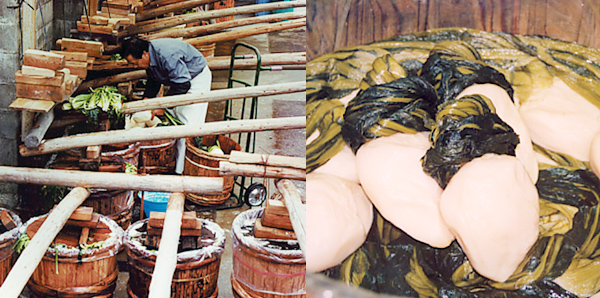

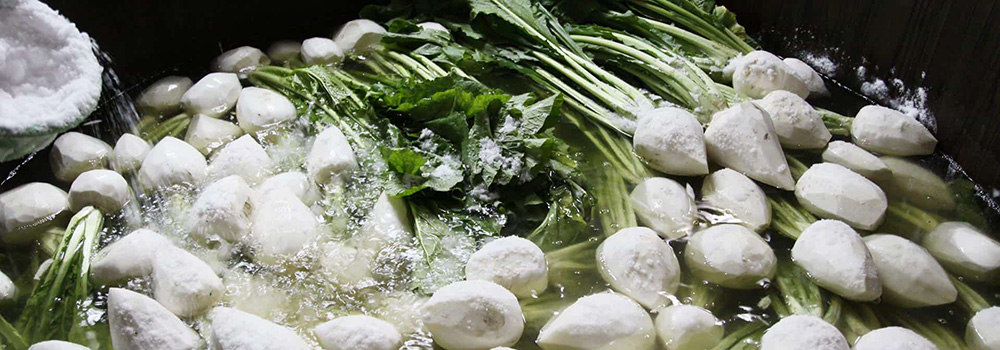

This flavor that originated in the Imperial Court was long kept secret.
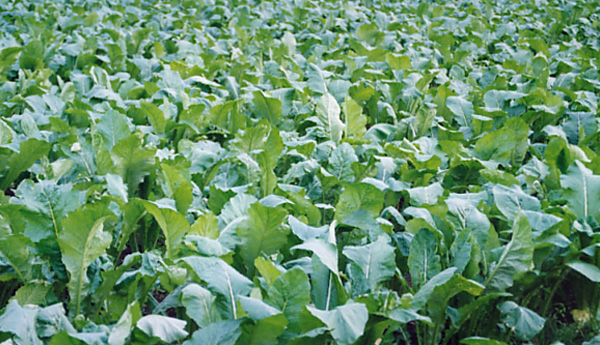
It is widely accepted that the cultivation and pickling of the Suguki turnip was begun by the shrine families of Kamigamo. One reason is said to be because the Suguki turnip can only grow in the narrow region of Kamigamo, west of Matsugasaki and north of Kitayama-dori. But the main reason is because the shrine families who worshipped at Kamigamo Shrine during the Momoyama Period obtained the seeds for the turnip and began growing it as a rare luxury gift for the elite, and for that reason, the process for making the pickles was long kept secret. The method was finally made public during a famine roughly 300 years ago to help refugees, whence it began to grow in popularity. The Suguki turnips are also known as Yashiki-na (mansion greens) for having been grown in the yards of shrine families, and as Gosho-na (palace greens) because the seeds were obtained by the shrine families who worked for the Imperial Palace in Kyoto from the Imperial Court. In the book Honcho Shokkan published around the Genroku Era during the Edo Period states that the turnips are named Suguki because of the sour taste they take on over time. Suguki Tsukemono became available for sale from the late Meiji period in Kyoto, and from the Taisho period in Osaka and Tokyo. Meanwhile, Suguki Tenbinzuke Tsukemono (pickled using a Tenbin or scale-shaped tool) represent a great discovery from the early Showa period.